
Launch update
Kimi K3 officially launches: open weights promised by July 27, early benchmarks put it near the frontier
Post-launch update on Kimi K3: the 16-of-896-experts architecture, the July 27, 2026 open-weights promise, and independent results from Artificial Analysis, Arena, and Vals AI.
Kimi K3 changed fast within two days. On July 16, 2026 TechCrunch was still summarizing a Financial Times report that this 2-to-3-trillion-parameter model would arrive "in the coming days". A day later its API documentation went live, and shortly after that Moonshot published a technical blog, announced the launch on its official X account, and promised full model weights no later than July 27, 2026. Independent evaluators like Artificial Analysis, Arena, and Vals AI have also posted early results.
This article is an update to the earlier launch analysis. The rule stays the same: product facts, vendor claims, independent evaluator results, and promises not yet delivered are kept separate. The most precise status for the model weights as of July 17, 2026: open weights have been officially announced, but not yet released.
Specs and architecture: the MoE details are finally out
The API docs and the technical blog both describe K3 as a 2.8-trillion-parameter model with a context window of about one million tokens, native visual understanding, Kimi Delta Attention (hybrid linear attention), and Attention Residuals. Its targets are long-horizon coding, knowledge work, and deep reasoning.
The most important new information sits in the Mixture of Experts configuration. The technical blog states that K3's Stable LatentMoE activates 16 out of 896 experts for a given token. That number describes sparsity, not the active parameter count; the size of each expert and the non-MoE components are not detailed enough to compute it, and Moonshot has indeed not announced an active parameter count.
Moonshot also mentions quantization-aware training with MXFP4 weights and MXFP8 activations, plus techniques like Quantile Balancing and Per-Head Muon. The vendor claim: roughly a 2.5x improvement in overall scaling efficiency compared to Kimi K2. The full technical report is still pending, so outside parties cannot verify that efficiency claim yet.
API contract and pricing: unchanged since day one
This part is still identical to launch. The model ID is kimi-k3, the base URL is OpenAI-SDK compatible, thinking mode is always on, and reasoning_effort on the public API only supports max for now. Sampling parameters like temperature and top_p are fixed and cannot be changed. Output limits: max_completion_tokens defaults to 131,072 and can be raised to 1,048,576. Context caching runs automatically for stable prefixes.
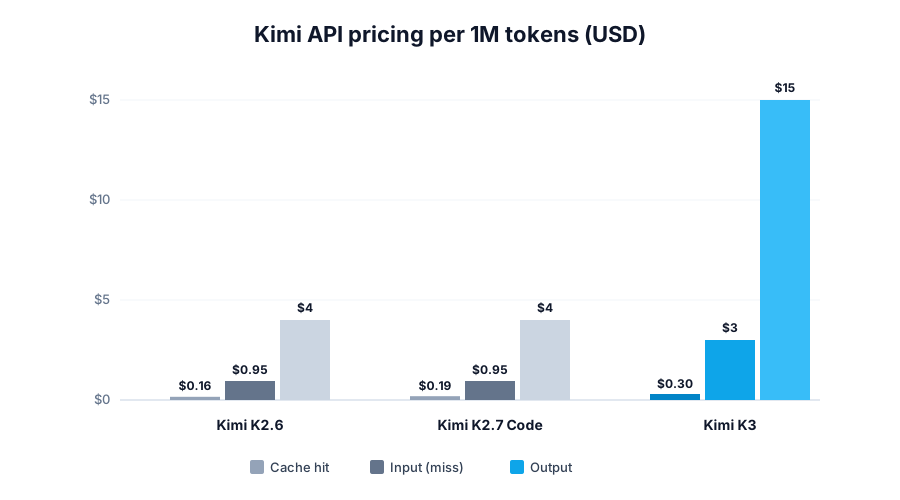
| Model | Cache hit | Input (cache miss) | Output | Context |
|---|---|---|---|---|
Kimi K3 (kimi-k3) | $0.30 | $3.00 | $15.00 | 1,048,576 |
| Kimi K2.7 Code | $0.19 | $0.95 | $4.00 | 256k |
| Kimi K2.6 | $0.16 | $0.95 | $4.00 | 256k |
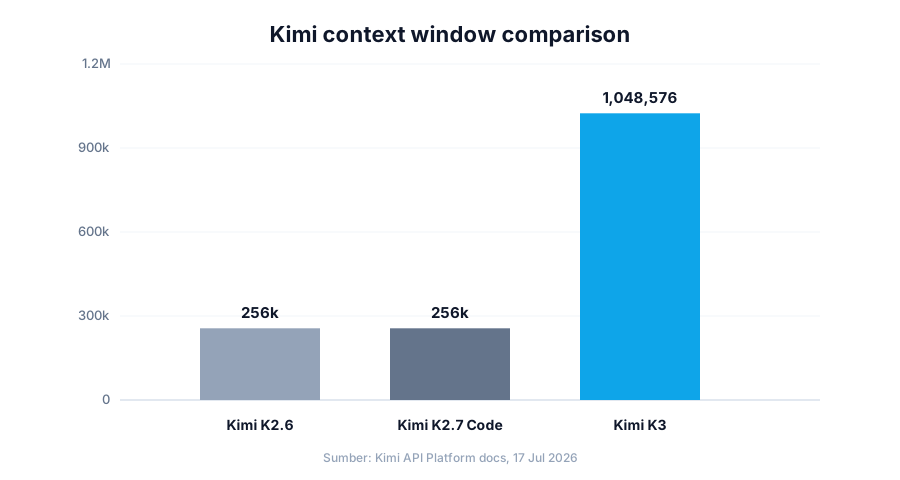
K3 offers roughly four times the context of K2.6 or K2.7 Code, at much higher input and output rates. The technical blog adds one operational claim: the official API reportedly reaches a cache hit rate above 90% on coding workloads. That is a vendor metric that depends heavily on workload shape and prefix stability, so treat it as an indication, not a guarantee.
There is one reproducibility note developers should know. The public API docs state top_p is fixed at 0.95, while the benchmark footnote in the technical blog says K3 results were run with temperature 1.0 and top-p 1.0. Until Moonshot explains the difference, the vendor benchmark table should not be treated as exactly reproducible through regular API requests.
Open weights: officially promised for July 27, not available today
This is the biggest status change since the first analysis. Moonshot now calls K3 an open 3T-class model and, both in the technical blog and the launch post on X, commits to releasing full model weights no later than July 27, 2026. The phrase "open weights by 27 July" is an announced deadline, not proof the artifact exists.
As of July 17, no K3 repo has appeared on the moonshotai Hugging Face org or the MoonshotAI GitHub org. There are no weight files, no license, no model card, no deployment guide. Artificial Analysis, Arena, and Vals also still label K3 as proprietary, which is fair because they can only test the hosted API.
Even if the weights ship on schedule, self-hosting will not be trivial. Moonshot itself recommends deployment on a supernode with 64 accelerators or more, and Reuters notes that K3's scale makes self-hosting unrealistic for many organizations. For most developers the API will likely stay the main route; open weights matter more for research labs, cloud providers, and companies with large inference clusters.
Vendor benchmarks: strong at coding and agentic work, not a sweep
The technical blog publishes a wide benchmark table. Every number below is vendor-reported: harnesses differ between KimiCode, Claude Code, and Codex, so the comparison is not an identical bake-off. A sample:
| Benchmark | Kimi K3 max | Claude Fable 5 | GPT-5.6 Sol | Claude Opus 4.8 |
|---|---|---|---|---|
| Program Bench | 77.8 | 76.8 | 77.6 | 71.9 |
| Terminal-Bench 2.1 | 88.3 | 84.6 | 88.8 | 84.6 |
| FrontierSWE | 81.2 | 86.6 | 71.3 | 66.7 |
| SWE Marathon | 42.0 | 35.0 | 39.0 | 40.0 |
| BrowseComp | 91.2 | 88.0 | 90.4 | 84.3 |
| GPQA-Diamond | 93.5 | 92.6 | 94.1 | 91.0 |
| HLE-Full | 43.5 | 53.3 | 44.5 | 49.8 |
| OmniDocBench | 91.1 | 89.8 | 85.8 | 87.9 |
This table does not support a headline like "K3 beats every American model". K3 leads on SWE Marathon, BrowseComp, and OmniDocBench, but trails badly on HLE-Full and loses to Claude Fable 5 on FrontierSWE. Moonshot itself admits K3's overall performance still sits below the strongest proprietary models in their own aggregate evaluation. That admission is rare in launch material, and it makes the rest of the table more worth reading.
Independent evaluators: one model, three stories
Artificial Analysis gives K3 a score of 57 on its Intelligence Index, ranked #4 of 189 models on its page when verified on July 17. Its performance profile is neither cheap nor fast: output speed around 62 tokens per second (below the comparison median), time to first token of 1.99 seconds (better than median), and the model is verbose. Running the Intelligence Index produced about 130 million output tokens at a cost of roughly $2,690.80, about twice the median. For agentic workloads that means price per token is not the only factor; measure cost per completed task.
Arena tells two different stories. On WebDev Overall, K3 ranks #1 with a score of 1679 (+17/-17), still preliminary, with about 1,757 votes as of July 16. On Text Arena Overall, K3 sits around #9 with a score of 1486 ±11 and about 3,024 votes. Both are snapshots that can shift as votes come in, and both should be read together: users strongly prefer K3's frontend output, but for general chat it is frontier-class without dominating.
Vals AI places K3 at #2 of 38 models with a Vals Index of 74.70% in its July 16 update. The components are consistent with the coding story: 95.10% on the SWE-bench Verified subset, 91.27% on the Vibe Code Bench subset, 80.90% on Terminal-Bench 2.1 (three full trials). Finance results are more moderate: 72.61% on CorpFin v2 and 55.88% on the Finance Agent v2 subset. Note the word subset; several Vals evaluations use subsets to keep testing fast, so the numbers are not always equivalent to full benchmarks.
How builders should read K3
| Need | Conclusion as of July 17, 2026 |
|---|---|
| Try Moonshot's strongest model via API | Available now: kimi-k3 with reasoning_effort: max |
| Frontend / web prototypes | Strong external signal (Arena WebDev #1), but still preliminary |
| Agentic coding and terminal tasks | Strong on Vals and the vendor table |
| General chat | Frontier-class, not #1 on Arena Text |
| Self-host today | Not possible; weights and license not out yet |
| Prepare to self-host after July 27 | Plan for a large cluster (vendor recommends 64+ accelerators) |
| Cost-sensitive workloads | Consider K2.x or hybrid routing; K3 is verbose |
Closing
The next ten days are the interesting part. Kimi K3 now has a much fuller evidence package: official specs, the 16-of-896-experts architecture details, a vendor benchmark table, and early results from three independent evaluators. The honest picture is not "K3 wins at everything" but "K3 has entered the frontier group with standout strength in coding and agentic work", while trailing on some reasoning evaluations and running fairly slow and token-hungry.
One thing has not changed since the first analysis: the weights are not out. What changed is the status, from "unconfirmed" to an official commitment with a date. Until the files, license, and deployment guide actually ship, K3 remains a hosted model. Read the quickstart and pricing before running long workloads, test your own repositories with clear acceptance criteria, and re-check Moonshot's Hugging Face and GitHub on July 27, 2026.
Sources
- Kimi API Platform: Kimi K3 Quickstart
- Kimi API Platform: Kimi K3 Pricing
- Kimi API Platform homepage
- Kimi API Platform: Model Parameter Reference
- Kimi API Platform: Thinking Effort
- Kimi Code
- Kimi K3 Tech Blog: Open Frontier Intelligence (Jul 17, 2026)
- Kimi launch post on X: open weights by 27 July 2026
- Kimi product homepage
- Artificial Analysis: Kimi K3 (snapshot Jul 17, 2026)
- Arena WebDev leaderboard (snapshot Jul 16, 2026, preliminary)
- Arena Text leaderboard (snapshot Jul 17, 2026, preliminary)
- Vals AI: Kimi K3 (Jul 16, 2026 update)
- Reuters: China's Moonshot unveils world's largest open AI model (Jul 17, 2026)
- Kimi Research blog (negative check for technical report, Jul 17, 2026)
- Hugging Face: moonshotai (negative check for weights, Jul 17, 2026)
- GitHub: MoonshotAI (negative check for weights, Jul 17, 2026)
- TechCrunch: Moonshot's upcoming Kimi 3 (Jul 16, 2026)
- Financial Times: pre-release report (paywall; via TechCrunch)
- Kimi API Platform: pricing hub


