
Qwen3.8-Max-Preview launches: 2.4 trillion parameters, access from $6 per month, and an open-weights promise with no date
Alibaba released its new flagship preview two days after Kimi K3. Access via Token Plan, Qoder, and QoderWork; a "second only to Fable 5" claim; but no model card, benchmark table, or per-token price.
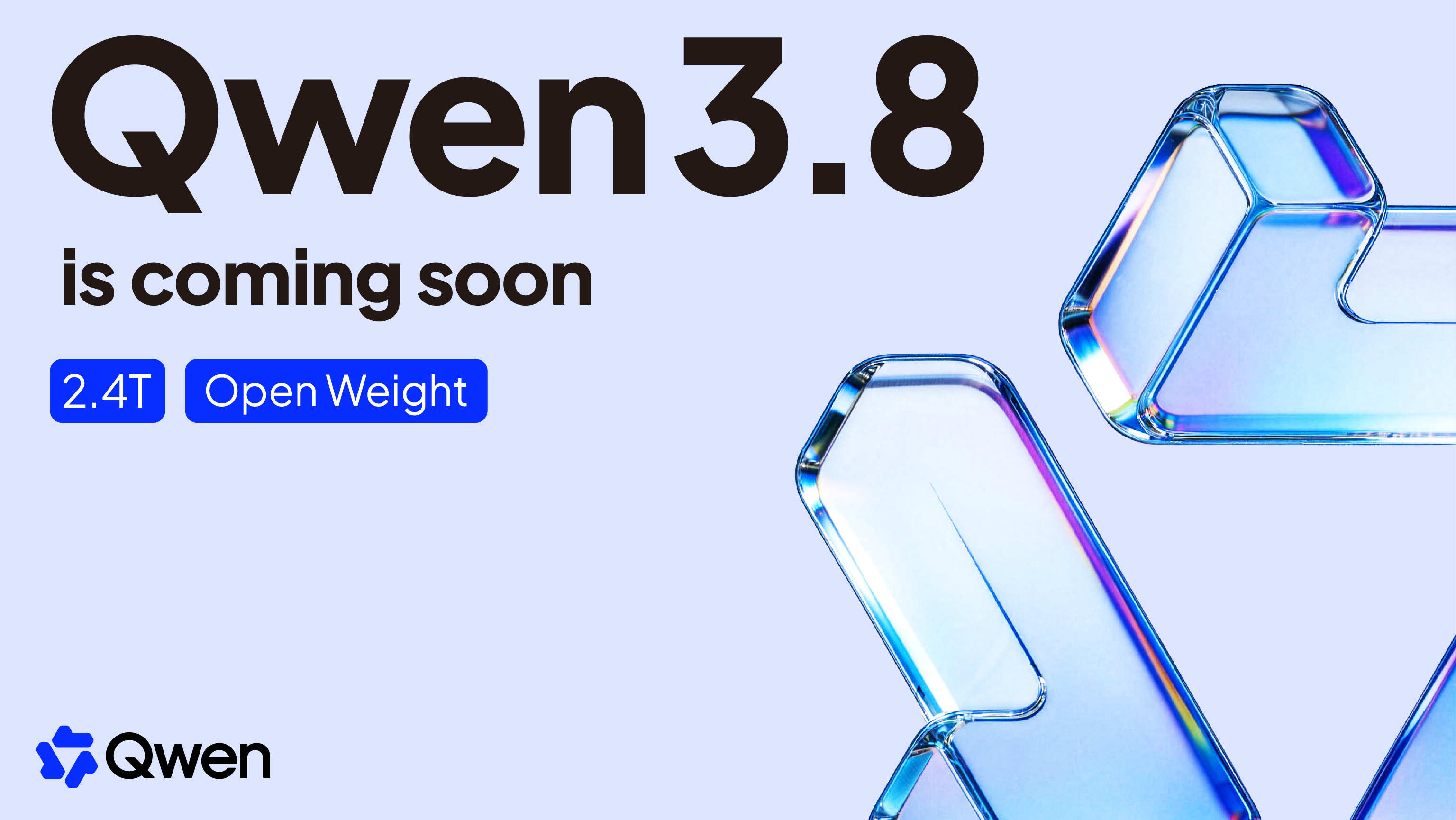
On July 19, 2026, the official Qwen account announced Qwen3.8, writing that it "is launching and going open-weight soon" with 2.4 trillion parameters, and called it second only to Claude Fable 5 among the models they tested. The version usable today is named Qwen3.8-Max-Preview, available through Token Plan subscriptions and the Qoder and QoderWork coding platforms. Bloomberg noted the Sunday launch arrived only days after Moonshot AI released Kimi K3, the 2.8-trillion-parameter model that briefly shook global tech stocks. The timing is hard to read as a coincidence.
What sets this launch apart from industry habit is how thin the supporting documentation is. There is no launch post on the official blog, no model card, no benchmark table, and no per-token price for the model. Bloomberg summarized it in one sentence: the announcement post named 2.4 trillion parameters but "provided no additional technical specifications". This article maps what is actually documented on launch day, and what is still only a promise.
What was announced, and what was not
The first-party facts available today come from two places: the official X post and the event page in the Qoder documentation. The Qoder page describes Qwen3.8-Max-Preview as the newest foundation model in the Qwen family with 2.4 trillion parameters, then claims significant gains over Qwen3.7-Max on coding and professional productivity (Cowork), including long-horizon tasks like full-stack development, data analysis, and Office workflows. Not a single number accompanies that claim. The phrase "still evolving" on the same page, echoed by "continuously evolving" in the X post, also signals that this preview can change behind the API without a name change.
The most interesting claim comes from personnel rather than product docs. Qwen developer Shuai Bai stated Qwen3.8 is the team's first multimodal model with more than 1 trillion parameters, capable of processing images, videos, and documents. The context is plausible: the official Qwen Cloud changelog records qwen3.7-max shipping as a text-only model in May, and only gaining visual understanding through a snapshot dated June 8. Even so, a social media statement is not a model card, so the multimodal capability remains a claim until official documentation appears.
The list of what is missing is longer than the list of what exists. There is no official context window, no active parameter count (2.4 trillion is the total, and Qwen's history is full of MoE designs that activate only a small fraction of parameters per token), no architecture details, no per-token price, and no entry in the official model changelog. The "second only to Fable 5" claim rests entirely on Alibaba's internal evaluation. This is the same position Moonshot was in when it first announced K3, and the test is the same: numbers from independent evaluators like Artificial Analysis and LMArena, which as of July 19 had not yet tested the model.
Access and pricing: subscription first, not per-token API
Alibaba sells access through subscriptions, not per-token pricing. The Token Plan Individual is now available "from $6/month" according to the official Qwen Cloud homepage, with three tiers: Lite for 1-2 parallel agents, Standard with 4x Lite credits for 3-4 agents, and Pro with 16x Lite credits for 6-8 agents. The official pricing page affirms compatibility with tools using the OpenAI and Anthropic protocols, including Qwen Code, Cline, Claude Code, Cursor, OpenCode, and Codex. That means existing coding harnesses can be pointed at Qwen3.8 without rebuilding the workflow.
There is one important caveat about the tier numbers. The official pricing page renders prices via JavaScript, so the per-tier amounts do not read from static HTML; the figures in circulation, namely Lite at $6 with 2,500 credits per 7 days up to Pro at $68 with 40,000 credits per same window, come from OfficeChai coverage. The official homepage writes "from $6/month" while OfficeChai writes that credits reset every seven days, and both can be true at once if billing runs monthly while the credit quota rotates weekly. Until the official page reads in full, treat the credit numbers as a secondary report.
For teams, the Token Plan Team Edition documentation lists explicit seat prices: Standard at $30 per seat per month with 25,000 credits, Pro at $100 with 100,000 credits, Max at $200 with 250,000 credits, plus a $700 shared package with 625,000 credits. The endpoints come in two flavors, OpenAI-compatible and Anthropic-compatible, with a single region in Singapore. The usage rules are worth reading before subscribing: the service is for interactive use in AI tools only, automated scripts and application backends are prohibited, and it is non-refundable.
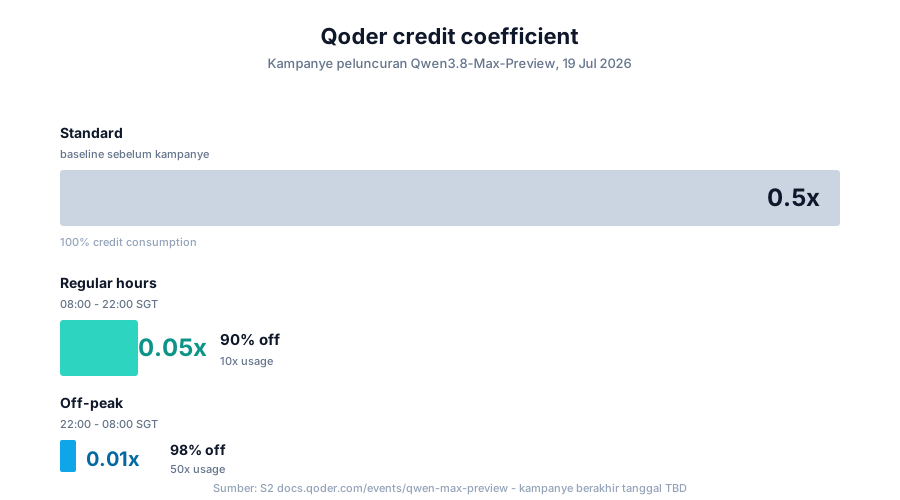
The most aggressive incentive sits in Qoder. The launch campaign cuts Qwen3.8-Max-Preview credit consumption by 90 percent, dropping the billing coefficient from 0.5x to 0.05x, and adds a 98 percent off night rate in the 22:00-08:00 SGT window. The campaign started July 19, 2026 with no announced end date, and applies automatically to all Qoder products including the 14-day Pro Trial for new users. Coverage describing the preview as sold "at 10 percent of the standard price" refers to this campaign, not to a permanent price list.
| Model (Qoder) | Standard rate | Regular hours (08:00-22:00 SGT) | Off-peak hours (22:00-08:00 SGT) |
|---|---|---|---|
| Qwen3.8-Max-Preview | 0.5x | 0.05x (90% off) | 0.01x (98% off) |
Alibaba's internal documents are out of sync
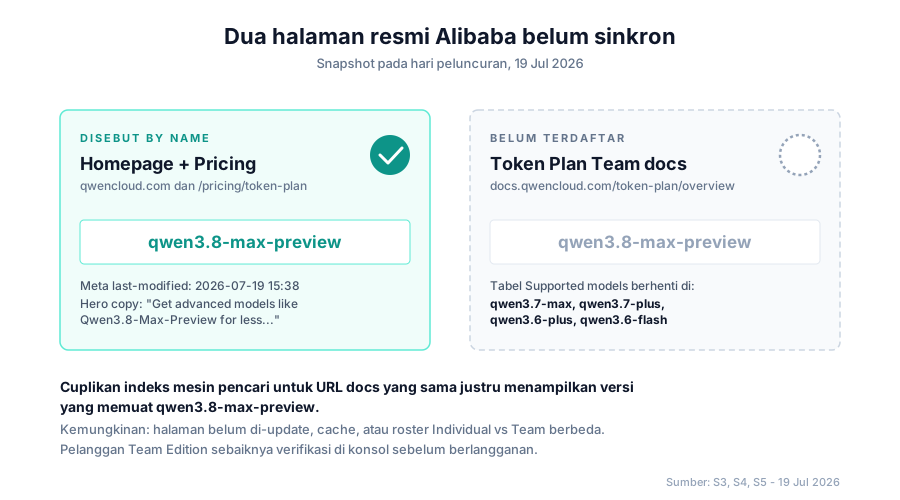
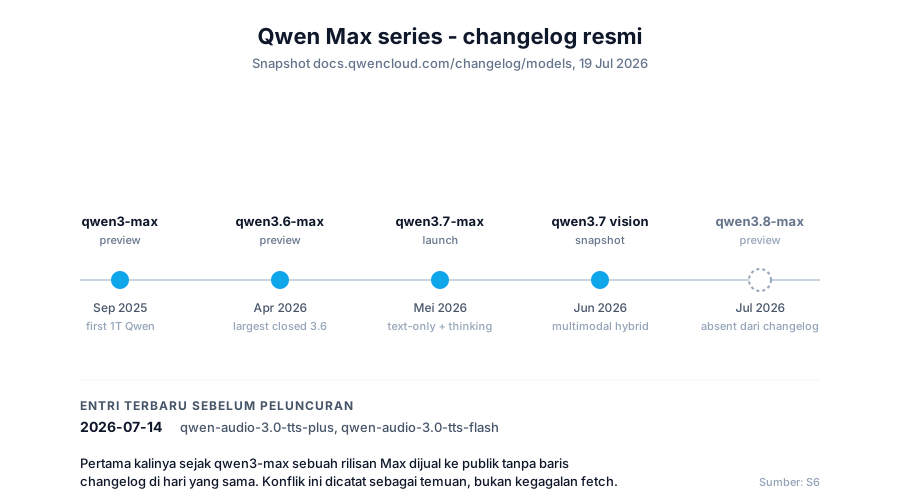
Alibaba's own official pages are not yet aligned on whether the model exists. The Qwen Cloud homepage and pricing page, whose metadata was updated on July 19, mention Qwen3.8-Max-Preview by name. But the "Supported models" table in the Token Plan Team Edition documentation, captured the same day, still stops at qwen3.7-max, and the official model changelog also has no qwen3.8 entry (its newest entry is a TTS model dated July 14). Curiously, the search engine index snippet for the same docs page actually shows a version that contains qwen3.8-max-preview along with a reference to a "Personal Edition overview".
This discrepancy is most likely not a product contradiction, but a combination of pages not yet updated, caching, or a roster that genuinely differs between the Individual and Team editions. The practical consequence is that Team Edition customers should verify model availability in the console before subscribing on the strength of Qwen3.8 alone. Writers covering the launch, meanwhile, should not quote the docs model table as final evidence during launch week.
The open-weights promise and the artifacts you can check
The open-weights promise is the most discussed part of the launch, and also the part with the emptiest artifact trail. The official post only says "going open-weight soon" with no date, in contrast to Moonshot, which gave an explicit July 27 date for K3's weights. A direct check on July 19 confirms the status: the Qwen Hugging Face organization contains 458 models without a single Qwen3.8 repo (its most recent releases are small ASR artifacts and Qwen-AgentWorld-35B-A3B), and a repository search in the QwenLM GitHub organization returns zero results for qwen3.8. One verification trap is worth noting: "Qwen3-8B", the 8-billion-parameter model from 2025, will always show up in a "qwen 3.8" search and is not the model in question.
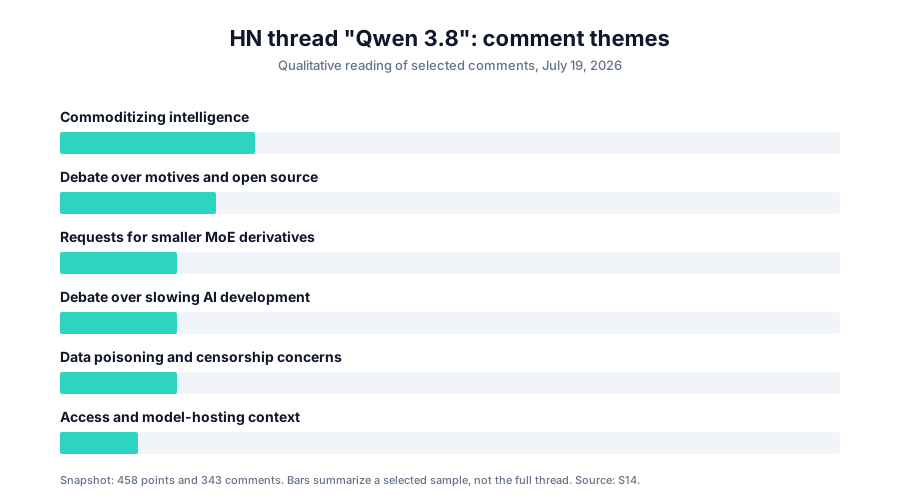
This closed-first pattern is not new for the Max line. OfficeChai notes that Qwen3-Max-Preview (September 2025) and Qwen3.6 Max Preview (April 2026) both launched as proprietary previews, and the official changelog itself calls qwen3.6-max-preview "the largest closed-source model in the Qwen3.6 series". On Hacker News, community hope is aimed at smaller derivatives instead; several commenters openly ask for MoE variants in the 35B to 122B range to run locally, because a 2.4-trillion-parameter model is clearly not a laptop artifact even if the weights eventually ship.

Position against Kimi K3 and the Chinese model field
It is hard to read this launch outside the K3 context. Bloomberg places the Sunday release "only days after" Moonshot, The Decoder reads Qwen's push as partly aimed at disrupting K3's momentum, and OfficeChai adds a detail that makes the rivalry odd: Alibaba holds about a 36 percent stake in Moonshot AI, so the two giant models now competing are partly funded by the same pocket. The Decoder, citing Bloomberg, also notes Moonshot only reached $300 million in annual recurring revenue in June and plans an IPO in as little as six months.
On scale, 2.4 trillion parameters puts Qwen3.8 in the same class as the 2.8-trillion K3, although comparing total parameters across MoE models says little about inference cost before the active parameter count is announced. OfficeChai frames it as the third major release from China in three months, after GLM 5.2 and K3, each of them open weight or moving in that direction. Early community reaction caught both sides at once: some read the wave as a deliberate commoditization of intelligence, while skeptics called Qwen prone to being a "benchmark princess" compared to K3 on their own small tests. One widely agreed-with comment read the "second only to Fable 5" claim as a backhanded acknowledgment of Anthropic's current moat.
There is also corporate context rarely mentioned in developer threads. Bloomberg notes Alibaba just caught a tailwind after Beijing approved Apple Intelligence, with Alibaba as the technology partner for Apple's AI offering in China. For Alibaba, Qwen3.8 reads as positioning for a broader AI infrastructure role, beyond the score contest within its own portfolio.
What is worth waiting for before moving workloads
For those who just want to try it, the math today is simple: subscriptions start at $6, the Qoder discount cuts credit consumption by up to 98 percent in off-peak hours, and the endpoint is compatible with the harness you already use. For those considering a workload migration, the table below separates what is settled from what is not.
| Builder question | Status July 19, 2026 | What would change it |
|---|---|---|
| Is the model real and usable | Yes; sold on Token Plan, Qoder, QoderWork | Already happened |
| How smart versus K3 / Fable 5 | Vendor internal claim only | Numbers from Artificial Analysis, Arena, and other evaluators |
| Cost per token | None yet; credit subscriptions only | Official model pricing page |
| Official context window and modality | Not announced; multimodal is a developer claim only | Model card or official launch post |
| Can it be self-hosted | Not yet; HF and GitHub empty as of July 19 | Weights release plus license |
| Will the promo price last | Campaign end date is TBD | Qoder announcement |
This launch is easy to try and hard to evaluate. Every incentive pushes you to use the model now, while every document needed to judge its claims has yet to be published. The healthiest way to treat it is to test on your own workload while it is cheap, record the results, and hold off on conclusions until independent benchmarks and the promised weights actually appear.
Sources
- Official announcement: @Alibaba_Qwen post
- Qoder event page (specs + campaign)
- Token Plan pricing
- Qwen Cloud homepage
- Token Plan Team Edition
- Qwen Cloud model changelog
- Hugging Face: Qwen (weights check, July 19, 2026)
- GitHub: QwenLM (repo check, July 19, 2026)
- Shuai Bai post (Qwen developer)
- Bloomberg via Yahoo Finance
- The Decoder
- OfficeChai
- Hacker News discussion


